

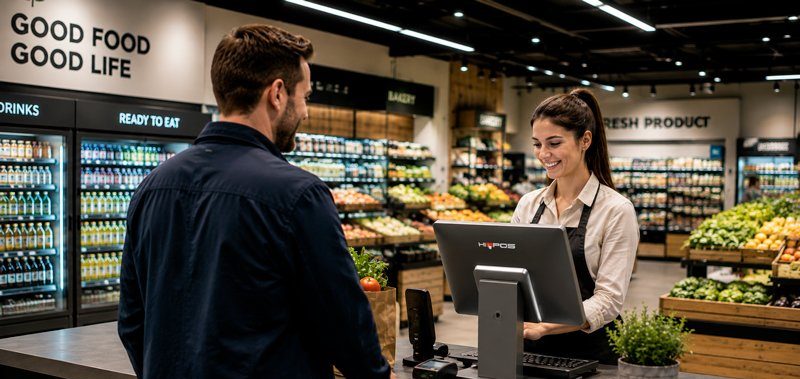
The Point of Sale (POS/TPV) has ceased to be a static cash register and has become the node where the customer, staff and transactional flows of the physical establishment interact.
Restaurants, hotels, supermarkets, specialty stores, and retail chains all share a common need: intuitive, agile POS software that can guarantee service continuity in the event of any technical issue. HIOPOS meets these needs by combining cloud architecture, Android mobility, fault tolerance through offline operation, and advanced self-checkout capabilities.
At IM Projects, after more than 16 years implementing Point of Sale technologies, we analyze how the HIOPOS platform adapts to the actual operations of each business.
HIOPOS Architecture: Centralized Cloud and High Availability Offline Operation
The risk of exclusive dependence on the Internet
In in-person sales, losing your network connection cannot mean halting billing. Connectivity outages at critical times cause bottlenecks, lost customers, and operational failures.
HIOPOS resolves this scenario through a hybrid structure:
- Centralized Cloud Management: Unified administration of catalogs, rates, promotions, multi-establishment control and real-time analytics accessible from any web browser.
- Offline Business Continuity: In the event of an internet outage, the terminals (fixed and mobile) maintain their local database active. Sales continue to be registered, orders taken, tickets issued, and payments processed.
- Bidirectional Synchronization: When the connection is restored, the accumulated data is automatically synchronized with the cloud without user intervention or service interruption.
The Android platform in the evolution of POS hardware
Choosing Android systems over traditional PC architectures offers direct operational advantages:
- Format Versatility: Facilitates running the same application on point-of-sale terminals, desktop tablets, handheld mobile ordering devices, and large-format kiosks.
- Hardware Flexibility: Android allows for a broad hardware ecosystem, with different formats and options for replacement or expansion according to the needs of the project.
- Agility in Operations: Native, lightweight, and intuitive touch interfaces that facilitate employee learning and adaptation.
Hardware and Mobility Ecosystem: Technology at the service of the workplace
POS software must be tailored to how sales occur in every part of the establishment. The HIOPOS compatible hardware catalog includes:
- Fixed Touchscreen POS Terminals: Designed for high transaction volume checkout stations.
- Android Order Pads and Portable Devices: They bring the POS system to the customer's table, the terrace, or the service area in the hallway.
- KDS (Kitchen Display System) and Customer Service Screens: They streamline communication between the order taking point, the preparation area (kitchen/bar) and the customer's view.
- Collection and Weighing Peripherals: Integration with barcode readers, commercial scales, PINPADs and automatic cash management drawers (CashDro).

HIOPOS by Sector: Solutions Tailored to Each Operation
| Sector | Operational Challenge | Recommended HIOPOS Configuration | Featured Functionality of the POS |
| Restaurants, Bars and Chains | Speed during peak hours, table turnover and order management. | Touchscreen POS + Android Ordering Devices + KDS + Self-Ordering Kiosks. | Automatic dispatch to preparation areas, division of accounts per diner and management of room layouts. |
| Retail and Specialty Trade | Assisted sales, speed at the checkout and customer loyalty. | Countertop terminals + Mobile tablets + Code/RFID readers. | Mobile customer service and payment, discount/promotion management and queue-free checkout. |
| Supermarkets and Food | High volume of references per ticket and need for extreme speed. | High-speed POS + Scales + SelfKiosk CQ. | Mixed sales by unit or weight, self-checkout areas and automated cash handling. |
| Hotels and Resorts | Management of multiple independent points of sale in the same premises. | POS systems in restaurant + Order terminals in Pool Bar / Terrace + Tablets in Spa and shops. | Centralization of data in the cloud and flexible allocation of devices according to the point of consumption. |

The Self-Service Revolution: Self-Ordering and Self-Checkout
The HIOPOS ecosystem integrates solutions where the customer interacts autonomously with the system, while also receiving personalized attention.
Self-Ordering (Restaurant and QSR)
Through self-service kiosks, customers can view the menu, configure their meal plan, and make payments directly.
Result: Reduced queues at the counter, optimization of kitchen/service staff and the possibility of boosting cross-selling through automatic suggestions during the ordering process.

SelfQuiosk CQ: Self-checkout for Supermarkets and Food Stores
In supermarkets and convenience stores (Grab & Go), SelfQuiosk CQ enables self-checkout zones where the user scans the codes of their products and completes the purchase.
It allows you to create combinations in the store with traditional staffed checkouts and automated checkouts, with payment by card or cash using CashDro.

SelfQuiosk RFID: Radio Frequency Checkout for Retail
In the fashion and retail sector, adapted with radio frequency tags:
- The customer places the items in the SelfQuiosk RFID reading zone.
- The system identifies items using RFID technology, avoiding traditional code-by-code scanning.
- The customer views the purchase summary on screen and proceeds to payment.
RFID technology thus allows for particularly agile checkout processes in establishments where products are correctly identified using this system.

Integration of the POS into the Company's Technological Ecosystem
The modern Point of Sale system shouldn't operate in isolation. To maintain financial and inventory consistency, HIOPOS is designed to connect with the organization's various platforms:
- Corporate ERP Systems: Sending sales data and cash closings to consolidate accounting and stock information at a central level.
- Hotel PMS: Possibility of making direct charges to the guest's room from different points of sale in the resort, such as restaurants, bars or spa, depending on the integration possibilities with the PMS used.
- Payment Gateways and Electronic Media: Integration with point-of-sale terminals (PINPADs), mobile payments via QR code and cash control systems.
- Delivery and Loyalty Platforms: Possibility of integrating online orders and customer programs within the Point of Sale technological ecosystem.
The Point of Sale within a Microsoft Dynamics 365 Business Central ecosystem
At IM Projects we specialize in projects where Point of Sale solutions must coexist and exchange information with ERP environments such as Microsoft Dynamics 365 Business Central, allowing us to design architectures where the operation of the establishment and corporate management are part of the same technological ecosystem.
Conclusion: The Point of Sale Adapted to Real Operations
Selecting a POS platform is not simply about replacing one terminal with another. It involves analyzing employee workflows, peak traffic times, preferred payment methods, and service continuity guarantees in the event of technical failures.
At IM Projects, with over 16 years of experience working with Point of Sale technologies, we support companies in the design, configuration and implementation of the HIOPOS ecosystem, designing an agile, scalable environment ready to integrate with corporate management.


